Translations

Showing posts with label Appalachia—Northeast Tennessee. Show all posts

Sunday, September 27, 2026

Tennessee's 67th State Park: The Clinch River Valley State Park in Hancock County (published 9-27-2026; article #575)

Introduction

That's a nice view! Lord willing, I hope to drive up soon to see it in person.

Thankfully, last Wednesday's strong line of thunderstorms finally dropped the temperature to seasonably cool fall weather. They also provided much-needed rain. Until then, September had been far too hot and dry for comfortable hiking in the early fall.

I could have gone out to explore the woods this afternoon. A joy of retirement, however, is that I can hike any day of the week, not just on weekends, which was my plight during my employed years.

The call of the forest must await the publication of this article about Tennessee's 67th state park. Located in nearby Hancock County, it is called the “Clinch River Valley State Park.” A better name would have been “Kyle’s Ford State Park.” After all, it is in Kyle's Ford, Tennessee.

How I Found Out About the New Park

As a subscriber to my hometown newspaper, The Rogersville Review, the postal delivery of the 8/26/2026 edition arrived late last month. Subscribers may read the online version at “New state park opens this week in Kyle’s Ford: Former River Place property has been transformed.” The Rogersville Review, Edition 8/26/2026, by Joanne Irvin.

To summarize the article, Friday, August 21, was the official dedication ceremony for the Clinch River Valley State Park (CRVSP), which is located in Kyle's Ford in Hancock County, Tennessee. The main entrance is at the intersection of state highways 33 and 70.

The State of Tennessee bought the 19.45-acre location formerly known as the River Place on the Clinch. The state also acquired 20 acres at Horton’s Ford, which is a few miles up the river from the River Place.

Initial work involves renovating the old store into a visitors’ center, which may include a restaurant. Small cabins are already nestled in the park. Some of them have running water, Wi-Fi, and small kitchens. The cabins may be available to rent by next March.

The park's mission focuses on river conservation, outdoor recreation, and Appalachian heritage. Guided river floats may be available now. Bluegrass music shows are planned.

Currently, the park is open from Thursday through Sunday from 8 AM to 4:30 PM. For more information, you can call 888-867-2757. The park's address is 2788 TN Highway 70, Kyle’s Ford, TN 37765.

I was delighted to learn about the new park. Again, it should have been named the “Kyle’s Ford State Park.” You could add “on the Clinch River.”

More About the Clinch River Valley State Park

You can learn more about the park by browsing around on Tennessee State Parks: Clinch River Valley State Park, as I did. As of the park's opening last month, it was the 67th and newest Tennessee State Park. The park is located approximately 70 miles northeast of Knoxville, Tennessee, and about 55 miles west of Kingsport, Tennessee.

The new park, along the Clinch River, consists of rolling hills, bottomland forest, and the biologically diverse river. It includes several scenic fishing locations. There are two biking (or hiking) trails. The Kyle’s Ford Riverside Ramble is an 18.2-mile paved trail, which begins at the General Store (the former River Place on the Clinch). The longer trail is the 44-mile Clinch River Gravel Loop trail. It is a partially paved and partially graveled trail, which includes the Kyle’s Ford Riverside Ramble.

Finally, the visitor center and general store in Kyle’s Ford offer information and places for folks to gather. Certainly, the area is rich in Appalachian history.

Conclusion

Back in the 1960s and 1970s, I remember riding with my father in his old pickup truck and going to Kyle's Ford. Dad may have had to work on or replace someone's water well pump or drill a water well in the area. At times, my parents took us boys over there for a day trip.

In the late 1970s and early 1980s, once I was older and had a car, I set out to visit and explore the scenic Kyle's Ford area on my own. I may have taken a young lady, whom I was dating at the time, over there to enjoy the views.

I haven't been over to Kyle's Ford in a long time. The next time I venture up to Hawkins County, will I take the time to drive over Clinch Mountain to check out the new Clinch River Valley State Park? Maybe so. If so, who wants to go with me?

This has been the 39th entry in the Appalachia—Northeast Tennessee topic section. I hope you have enjoyed it.

Wednesday, August 12, 2026

August 8th: Annual Emancipation Day (published 8-12-2026; article #571)

Leffler, Warren K., photographer. Civil rights march on Washington, D.C. / WKL. Photograph. Retrieved from the Library of Congress, <www.loc.gov/item/2003654395/>. No known restrictions on publication.

Introduction

As it is said, “You learn something new every day.” Well, maybe not every day. Early last Sunday morning, a local television news station taught me something I had not known in my sixty-six youthful years of living.

To emancipate is to free from the control or power of another. In short, it is to be set free from bondage.

What did I learn? I found out that the 8th of August is the annual celebration of Emancipation Day. Why, as far back as I can recall, had I not heard about the day before? I don't remember hearing about the day until early last Sunday morning.

Annual Emancipation Day on August 8th

According to sources (listed below), on August 8, 1863, during the American Civil War (1861–65), Tennessee Military Governor Andrew Johnson freed the slaves he “owned” at his home in Greene County, Tennessee. This was after President Abraham Lincoln issued the Emancipation Proclamation on September 22, 1862, which became effective on New Year's Day 1863.

A few years afterward, Sam Johnson, formerly enslaved by Andrew Johnson, began to promote the annual observance of August 8th as Emancipation Day in Greene County. In time, the annual celebration spread to other towns in Tennessee and in nearby states.

In 2007, Tennessee Governor Phil Bredesen signed a bill into law, which acknowledged August 8th as annual “Emancipation Day.” Unless I missed them, I was not aware of special celebrations on August 8th until last Sunday morning.

For further reading about Emancipation Day on August 8th, I suggest the following sources:

“'When we know better, then we can do better' | Knoxville historians share stories of resilience ahead of Emancipation Day.” WBIR-TV (Knoxville), by Lexie Martin, 8/7/2026. I may have seen a repeat of the televised version of this article early last Sunday morning.

“The Eighth of August: Emancipation Day in Tennessee,” Tennessee Historical Society, by Skyler Gordon, 8/3/2018. The brief article begins with an observance in Clarksville, Tennessee, on August 8, 1941. It also reflects back to a celebration in the same town on August 8, 1898.

The National Park Service: Andrew Johnson National Historic Site in Greeneville, Tennessee, includes the following noteworthy entries: Emancipation Day (last updated 4/14/2015), August 8th (last updated 7/24/2020), and Slaves of Andrew Johnson (last updated 7/20/2023). In summary, the columns elaborate on the lives of the slaves whom Andrew Johnson freed.

The Beck Cultural Exchange Center in Knoxville, Tennessee, includes a column titled “Eighth of August History.” A section of it describes annual celebrations in Chilhowee Park during segregation. Also included is a link to an East Tennessee PBS documentary from August 8, 2016. Finally, three additional links direct to “More About the Eighth of August.”

I was pleased to discover Black in Appalachia: 8th of August: Tennessee's Celebration of Emancipation. The brief article embeds an audiovisual presentation, which is also available at “The 8th of August: Tennessee's Celebration of Emancipation,” Black in Appalachia (YouTube), 8/5/2022. Looking through the website, I learned the organization is headquartered in nearby Whitesburg, Tennessee. I may plan to visit them.

Finally, Tennessee State Museum: The History of Emancipation Day in Tennessee, by Stephanie Davis, 8-27-2021, includes an excellent historical synopsis of August 8th.

Conclusion

It is fitting for this brief article to become the 38th entry in the Appalachia—Northeast Tennessee Topic Section. I learned something profound early last Sunday morning. It began in nearby Greene County, Tennessee, on August 8, 1863. Once freed, Andrew Johnson's slaves did not wish to return to slavery. They were free to flourish as free men and women. Their accomplishments are described in the sources cited above.

Quoting from my inaugural article (3/6/2006), “To a true Appalachian, skin color doesn't matter. Of course, our necks may be a little red from getting out and actually working for a living, but you can be red, yellow, black, brown, or white and still be an Appalachian! Understand?”

This entry honors the freedom won by and the accomplishments of fellow Appalachians, deceased and living, with skin color darker than mine. We are relatives through the lines of the first man and woman, Adam and Eve. Every human is kin to one another. If all people could understand this relationship, nations and people groups would not antagonize each other.

To be emancipated from the evils of slavery is to be set free. Closing on a deeper spiritual point, my short story from August 14, 2022, briefly mentions my emancipation from sin and conversion to Christ on Monday, June 22, 1981.

I was once a spiritual slave, under Satan's control. However, as the Apostle Paul stated in Galatians 5:1, “It is for freedom that Christ has set us free. Stand firm, then, and do not let yourselves be burdened again by a yoke of slavery” (NIV).

Are you free in Christ? If so, you are my spiritual relative. Are you still a slave to sin? If so, unyoke yourself by becoming a servant of Jesus. If you would like to begin a confidential conversation along this line, please email me using the Contact Form on this website. I am a former slave, whom Christ set free. I would like to share that freedom.

Finally, this article remembers my maternal grandmother, Lula Frank Amos Wood (6/16/1901-8/12/1991). Granny Wood went to her everlasting freedom 35 years ago today.

Friday, April 17, 2026

Tuesday, 4-14-2026, Fire on House Mountain: 100% Contained, but Still Closed for Hiking (published 4-17-2026; article #552)

Introduction

On Tuesday morning, three days ago, my wife called at 7:18 AM to break the news, which she heard on a local radio station while driving to work. At the time, I was in my home office and passively listening to a local news station on the living room television. The station had not yet aired a segment about the fire. A few minutes after my wife's call, however, WVLT-TV, Knoxville, aired a brief segment, which is not available online, about the fire on House Mountain State Natural Area.

This 37th entry in the Appalachia - Northeast Tennessee Topic Section serves as a public service announcement to hikers outside the Knox County, Tennessee, area. It is about the fire, which was contained the next day. The hiking trails, however, are closed for the time being.

The Fire

Last Tuesday afternoon, I found online “Fire burning on House Mountain,” WVLT-TV (Knoxville), 4/13/2026. (The date is incorrect.) The actual 4/14/2026 audiovisual episode (updated at 1:02 PM) is almost five and a half minutes in duration and describes the fire and the efforts to extinguish it.

From Knox News: Data Central: Fire and Smoke: Knox — House Mountain, I learned that someone discovered and reported the fire at 2:58 AM last Tuesday. What started the fire? The cause is still under investigation. The recent dry, warm, and windy weather could certainly kindle any spark into a fire. The park is open from sunrise to sunset, but it closes after dark. Before sunset on Monday, did a careless hiker drop a lit cigarette, which later ignited the fire? In the early hours after midnight, did a pyromaniac ascend the steep slopes of the mountain to intentionally start the fire?

As an aside, I recall hiking on House Mountain several years ago, not long after a fire on the northwest face of the mountain was extinguished. I saw scorched ground, fallen trees, and burn marks on standing trees. My hiking record does not include notes about a previous fire on the mountain. Online, however, I found the following article from June 2020, which mentions a fire: “Rural Metro: Fire on House Mountain contained.” WBIR-TV (Knoxville), by Staff, 6/21/2020.

My Investigative Visits to House Mountain

So far, I have made two investigative visits to House Mountain. The first visit includes three photographs.

Wednesday, April 15th

On Wednesday morning, a day after the fire started, local news media reported that the House Mountain fire was being contained. Several acres had burned or were still burning.

Early that afternoon, driving north on Washington Pike, I saw smoke rising from the northern side of House Mountain near the northeast bluff. Additional smoke was ascending from the middle bluff and upper-middle bluff on the northwest side of the mountain.

I parked outside the upper parking lot, which was barricaded closed. Only official vehicles were in the parking lot. The scent of smoke was noticeable. I walked down two-tenths of a mile to the lower parking lot. Empty of vehicles, it too was barricaded.

After walking back up to the upper parking lot, I photographed it at 2:04 PM:

The view looks west. My silver 2006 Frontier is parked outside the lot. The U-Haul van may have contained supplies and equipment for the firefighters. I did not see anyone in the area.

I decided to drive east down Hogskin Road and turn left (north) onto Idumea Road. After a few miles, I parked across the creek near a barn and walked back across the bridge, which spans the creek, to where Idumea Road and Childs Road intersect. At 2:30 PM, I photographed the following view of the northeast bluff and northeast side of House Mountain:

The view looks south. I was standing under shade trees and in front of a gate, which opens to the field in the foreground. The wind blowing from the south smelled of smoke.

Back in my truck, I continued north to where Idumea Road comes out onto Washington Pike. Turning left, I continued west a few miles on Washington Pike.

Turning left onto Stephens Quarry Lane (a dead end), I stopped to take the final photograph below at 2:42 PM:

The view looks east. The smoke is noticeable coming from near the upper and lower middle bluffs on the ridge.

Thursday, April 16th

Yesterday, Thursday, I returned to the upper parking lot at House Mountain, parking again in the same location as the day before. The barricades were still in place.

Before leaving home, I left the Knox County Department of Parks and Recreation (865-215-6600) a voicemail. Further, I tried to reach someone at the local Tennessee Division of Natural Areas – East TN Office (865-594-5601), but the line never did ring.

I had not been out of my truck long when a man, perhaps in his 50s, and his dog arrived. He parked outside the parking lot, near my truck. An avid hiker, he is trying to reach his goal of hiking every state park in Tennessee. His dog and he were from Watertown, Tennessee, 40 miles east of Nashville and 10 miles southeast of Lebanon. The drive from Watertown to House Mountain took around two and a half hours.

The man had not known about the fire and temporary closure of the park. A congenial gentleman, he and I talked about nearby trails and our hiking experiences for a few minutes. His truck bed camper was decorated with scripture references from the Bible. I was glad to meet a brother in Christ who also enjoys hiking!

Undaunted, the man and his dog ventured onward in search of another nearby state park, which they had not yet hiked.

Conclusion

My wife and I live under 10 miles away from House Mountain, which is a main reason why I hike there often. If we lived farther away, such as the man I met yesterday, I would be disappointed to drive a great distance to learn that the park was closed.

That's why this article serves as a public service announcement for hikers outside the Knox County, Tennessee, area. Before you plan a trip to hike House Mountain, please call the Knox County Department of Parks and Recreation (865-215-6600) to find out if the park is open again.

Last evening, this area received a much-needed rain. Over this coming weekend, I plan to take the short drive back to House Mountain to see if it is back open for hikers. If so, Lord willing, I hope to publish an article about my 209th hike on my mountain. Please stay tuned, dear reader!

I almost forgot to mention that today the Knox County Department of Parks and Recreation returned my voicemail from yesterday. I offered my assistance as needed. Hopefully, someone will call and ask for my help.

Monday, September 08, 2025

Recommending Jared King TV on YouTube! (published 9-8-2025; updated 9-18-2025 and 4-15-2026; article #535)

Photograph from 10/29/2010 by M. Fearghail at Panther Creek State Park. It is the fifth of eight photographs from the park that are included in the article Four Hikes in Four Days! (published 11-14-2010).

4/15/2026 urgent update: From yesterday evening's anonymous comment below, this 9/8/2025 article is revised and no longer recommends Jared King TV. His YouTube channel has been taken down. A few days ago, I listened to an episode, in which he explained problems between YouTube and him. My reply to the anonymous comment, also below, requests proof of the allegation made. Searching online, I have not yet discovered any proof. My prayer for Jared King and his family is that they continue to seek God's face and live according to his will. This update does not judge Jared King. Simply, since his YouTube channel is down, I can no longer recommend it.

9/18/2025 important update: King Fest that was scheduled for this Saturday, 9/20/2025, from 12 to 5 PM at Panther Creek State Park has been postponed!

Donnie Laws and Jared King plan to reschedule the occasion for a larger venue. The location, date, and time are being determined. For more details, please watch on YouTube “King Fest Cancelled for September 20th,” Donnie Laws: East Tennessee Outdoors, 9/17/2025, and “KingFest POSTPONED: We Gotta Get A Bigger Place!!!” Jared King TV, 9/17/2025. Apparently, more folks were planning to attend than the pavilion could accommodate.

 
Introduction

Greetings, dear reader, to the 36th entry in the Appalachia-Northeast Tennessee topic section! Almost 15 years ago, I photographed the above pristine snapshot of a secluded area at Panther Creek State Park. The location was along an inlet on the Cherokee Reservoir from the Holston River. The 1,444-acre state park is located about six miles west of Morristown, Tennessee.

Why do I include a photograph from Panther Creek State Park in this article that recommends the Jared King TV channel on YouTube? Well, read on, fellow Appalachian heritage enthusiast, and I will explain!

From Donnie Laws to Jared King

The article from 4/4/2023 recommended Donnie Laws: East Tennessee Outdoors on YouTube. Further, his YouTube channel is mentioned kindly in the 7/28/2022 article about Cades Cove and in the 9/13/2023 entry that explains how to pronounce “Appalachian.” Finally, Donnie Laws' channel is one of eight entries under the “Appalachian Heritage” section on the lower right side of this web page.

I stop by at times to listen in to what Donnie Laws has to say. Last Tuesday evening, I happened to catch his episode “King Fest 2025: Come Meet and Talk with Us on September 20th at Panther Creek State [Park].” Donnie Laws: East Tennessee Outdoors (YouTube), 8/27/2025.

In the episode, Donnie Laws mentioned that Jared King will be with him on Saturday, September 20th, at Panther Creek State Park. The comment that I left that evening was, “Lord willing, I hope to meet you there. The mountains are calling me. I must go soon!” Later that day, Donnie Laws replied, “Awesome, my friend. Thanks for sharing. Be careful on the road. God bless you.”

Recommending Jared King TV (YouTube)

The next day, I was pleased to find and check out Jared King TV on YouTube! From McMinnville, Tennessee, Jared King's channel started on 5/7/2020. As of last Saturday, his channel included 636 videos, had almost 81,000 subscribers, and had just under 9,500,000 views.

The channel description (slightly redacted) includes the following:

APPALACHIAN STORIES & BEYOND! Hey folks! Come sit a spell while I tell some old-timey Appalachian stories, from witches and haints to just how times were back in the old days in the mountains and all around the world. Yep, ya never know what I'll do next! God bless you and your kin, and have a good'n.

Later that day, I enjoyed a few laughs while watching “Appalachian Humor: Sayings and Expressions (FUNNY).” Jared King TV (YouTube), 1/11/2025. In just over three and a half minutes, Jared King shares and explains several humorous Appalachian sayings. The description states, “You'll learn about the unique and insightful ways Appalachian people express their love and values for family. You'll be surprised by the wisdom and humor found in their sayings, many of which are passed down through generations.”

Afterward, I left the following comment:

Jared King, greetings! I happened to catch Donnie Laws' episode about you and him coming to Panther Creek State Park on the 20th of this month. Lord willing, and the creeks don't rise, my wife, the long-suffering Mrs. Appalachian Irishman, and I hope to meet Donnie Laws and you then! In the meantime, keep on turnin' right and goin' straight out there. Ya hear? In a few days, I plan to publish an article on my website that encourages readers to tune into your channel. Yep, I enjoy tossing out a favorite Appalachian phrase when I'm around city slickers! I enjoy the expressions on their faces. Of course, as an educated country boy, I explain what I meant in city slicker terminology!

Jared King's reply later that day was as follows (slightly redacted):

Well, howdy, brother! Sure is good to say hi to ya, and I definitely hope to get to meet y'all at Kingfest! Also, thank you so, so much for spreading the word about my channel! Good folks are getting hard to find nowadays, so it's always a blessin' to meet good folks like y'all. Educated or not…a good ole Appalachian feller…is a good ole Appalachian feller in my book! God bless y'all, and have a mighty good'n!

I believe that Donnie Laws and I are of the same generation. Jared King is from a younger generation, but he upholds the good in Appalachian heritage. Further, and more importantly, Donnie Laws and Jared King, as Christians, seem to uphold the biblical worldview.

This country and the world could find wisdom (along with good humor) from the good in Appalachian heritage. Ultimately, every soul should seek and find the “pearl of great price” (Matt. 13:45-46) by following the biblical worldview that leads to salvation and everlasting life.

For these reasons, this article highly recommends Jared King TV on YouTube! Sit a spell, and tune in to watch and listen for a while. It may do your heart and soul some good!

Conclusion

This article encourages you, dear reader, to check out Jared King TV on YouTube. Further, as a shout-out to Donnie Laws, please also visit his previously referenced YouTube channel.

To readers in northeast Tennessee, especially near Panther Creek State Park, you may want to set aside some time on Saturday, 9/20/2025, from about 12 to 5 PM, to meet Donnie Laws and Jared King at King Fest. The location will be the Smallman Pavilion. (You will see the name and location if you click the link, scroll down, and hover over the pavilion on the lower right side of the screen.)

Further, the Panther Creek State Park Map opens an image, which you should be able to enlarge to 300% to see the Smallman Area. Additionally, Google Maps: Panther Creek State Park can help with driving directions. Practically, from Highway 11E just west of Morristown, Tennessee, turn northwest onto Panther Creek Road (Highway 342). You will see the BP service station. After winding along the road for a while, turn right (northeast) onto Panther Creek Park Road. The welcome center will be up to your left. A stop there could be informative. Otherwise, continue to wind down along Panther Creek Park Road. After crossing the small bridge over Panther Creek, you will drive uphill for a while. Finally, once on the ridge, you will arrive at the Smallman Pavilion. Restrooms, picnic tables, cookout grills, and parking are also available. The surrounding views are remarkable.

Lord willing, and if the creeks don't rise, the long-suffering Mrs. Appalachian Irishman and I plan to be at the Smallman Pavilion in Panther Creek State Park on Saturday, 9/20/2025, around 12 PM. I look forward to meeting and shaking hands with Donnie Laws and Jared King, both true Appalachians who uphold the good in Appalachian heritage. Also, friends and family members, whom I have told, are planning to stop by that day.

If you live nearby, I hope to see you there! Please share this article, and encourage everyone you know to attend. A great time should be had by all!

Tuesday, May 13, 2025

Earthquake Rattles the East Tennessee Region on Saturday, 5-10-2025 (published 5-13-2025; article #525)

 Introduction

The seismic fissures on the structure in the above image were from a few years ago in Doha, Qatar. Three days ago, however, our house shook but sustained no damage. The earthquake at 9:04 AM on Saturday, May 10, 2025, was one to remember!

Welcome, dear reader, to the 35th article in the Appalachia—Northeast Tennessee topic section. If you live in the region, or even in the Carolinas, Georgia, or Kentucky, you may have felt the tremors. It was a literal seismic shift that lasted a few seconds.

The Earthquake

Three mornings ago, the weather outside was mostly cloudy and seasonably cool. Indoors, Mrs. Appalachian Irishman was sitting on a sofa in the living room, watching a television show that only a woman could enjoy. I was sitting at my home office desk, reading an article online.

The time was 9:04 AM. At first, it sounded and felt like a heavy train coming down the railroad track. The track runs parallel near the back of our property. Trains run infrequently.

That was no train! Looking out my office windows, it seemed as if the ground was vibrating. Our ten-year-old “puppy,” Molly, however, was sitting in the driveway normally, apparently unaware of any movement beneath her. Our house must have been shaking slightly. It was disorienting. Glass cups placed closely together in a kitchen cabinet began to rattle. The rather disturbing sensation lasted only a few seconds.

A few minutes after the shaking stopped, a next-door neighbor called to ask if we had felt an earthquake. My wife, who answered, told him yes. Indoors, he said that he had felt it. He said that his wife, who was in the basement at the time, didn't feel anything. He had already called his father, who lives a couple of miles away. His father, outside at the time, said that he didn't feel anything. I heard about people, driving at the moment the earth shook, who didn't feel the earthquake.

Evidently, to feel the earthquake, you had to have been indoors, not in a basement, outside, or driving.

One of several articles about the earthquake is “A Tennessee earthquake rattles homes as far away as Atlanta with 4.1 magnitude,” Associated Press (AP), by Ben Finley and Bill Cormier, 5/10/2025. The federal government account with plenty of details is at the U.S. Geological Survey (USGS): M 4.1 - 21 km SE of Greenback, Tennessee: 2025-05-10 13:04:20 (UTC).

Conclusion

My wife and I lived in Charleston, Missouri, from 1986 to 1992. We remember the earthquake that shook the ground there in the late 1980s or early 1990s. Looking out a window, I saw the front porch metal rail and posts shaking. Coming down a set of stairs at another location, my wife felt the staircase shake. The earthquake last Saturday was also one to remember.

In the New Testament, the inspired record of Jesus' Sermon on the Mount is in Matthew, chapters 5-7. Jesus concluded his sermon in Matthew 7:24-27. The spiritually wise who hear the words of the Lord are like a man who built his house on the rock. Strong rainstorms and wind batter the house, but it will not fall, since its foundation is on the rock.

Last Saturday, our physical house shook but received no damage. Our spiritual house, however, did not shake, for it is built on the Solid Rock, Christ Jesus! See Matthew 7:24-27, 1 Corinthians 10:1-13 (especially verse 4), and 1 Peter 2:1-10 (particularly verses 4-5).

Dear reader, if your spiritual house is shaken by not having its foundation in Christ, and if you would like to communicate privately, please use the “Contact Form” on this website to email me. That will start our confidential dialogue. My purpose is to help those who need to find firm footing on the Solid Rock.

Monday, September 23, 2024

On 9-18-2024, was Clingman's Dome renamed Kuwohi or Kuwahi? (published 9-23-2024; article #491)

Sunday afternoon photograph, on 10/28/2007, by M. Fearghail, of the observation tower on Clingman's Dome (as it was named at the time). Mrs. Appalachian Irishman was standing centered, looking toward the setting sun, wearing a light blue sweatshirt.

Introduction

Is the new name for Clingman's Dome, in the Great Smoky Mountains National Park, spelled with an “o” or an “a”? How is Kuwohi or Kuwahi pronounced? This thirty-forth entry in the Appalachia - Upper East Tennessee topic section wants to know! The conclusion has the answer and shares how the new name is pronounced.

Foremost, it was named Clingman's Dome, not Clingmans Dome. The apostrophe was required to show the possessive case. This website's article from 7/14/2022 explains that the location had been named after Thomas Clingman, and it tells who he was.

Kuwohi: the Official Spelling

The official name change from Clingman's Dome to Kuwohi was on Wednesday, September 18. A local television news station informed us. One online source (with my grammatical corrections added in brackets) is “Clingman[']s Dome name change proposal approved[;] Kuwohi name restored to Smokies mountain[.]” WATE, by Hannah Moore and Melanie Vásquez Russell, 9/18/2024. The article includes the following (with my bracketed corrections added):

On September 18, the U.S. Board of Geographic Names voted in favor of the request submitted by the Eastern Band of Cherokee Indians (EBCI) to change the name of Clingman[']s Dome to Kuwohi.

Kuwohi means “mulberry place[,]” and the National Park Service shared [that] the Cherokee syllabary for the name is ᎫᏬᎯ. Kuwohi holds a significant meaning to the EBCI, whose leaders today say the place of mulberries is a sacred summit that also served as a refuge for past Cherokee people avoiding forced relocation to Oklahoma, or the Trail of Tears.

Kuwohi is the highest point in Tennessee[,] and the observation tower offers visitors to the summit 360° views of the Smokies. It was renamed after Confederate General Thomas Clingman, who was said to be the first person to accurately measure the peak’s elevation.

The following federal website article confirms Kuwohi as the officially correct spelling: “Kuwohi name restored to the highest peak in the Smokies: U.S. Board of Geographic Names approves Eastern Band of Cherokee Indians name change request,” National Park Service: Great Smoky Mountains National Park, by Katie Liming, 9/18/2024. The first paragraph includes the following (with my bracketed correction for Clingman's added):

The U.S. Board of Geographic Names voted today in favor of the formal request submitted by the Eastern Band of Cherokee Indians (EBCI) to change the name of Clingman[']s Dome (FID #1326387) to Kuwohi (pronounced koo-WHOA-hee). Kuwohi is the Cherokee name for the mountain and translates to “mulberry place.” In Cherokee syllabary, the name is ᎫᏬᎯ.

Other recent online news sources that I saw also spelled the new name for Clingman's Dome as Kuwohi. As an aside, most of those sources misspelled Clingman's without the apostrophe.

Kuwahi: an Alternate Spelling

Two years ago, online articles indicated that Clingman's Dome was to be renamed Kuwahi, with an “a,” not an “o.” For example, my 7/14/2022 article (The Solid Rock: Clingman's Dome, Kuwahi, or Christ?) cites a 7/8/2022 local news article, which mentioned that Kuwahi would be the new name.

Several other articles from 2022 indicate the proposed name change to Kuwahi. For example, with my bracketed corrections added, see “Clingman[']s Dome name change to be discussed by Cherokee Tribal Council,” WATE, by Melanie Vásquez Russell, 7/8/2022. The first paragraph states (including my bracketed correction):

The Eastern Band of Cherokee Indians Tribal Council is slated to discuss a resolution that, if passed, will begin the tribe’s process of petitioning the federal government to restore the name, “Kuwahi” to the mountain currently known as Clingman[']s Dome in the Great Smoky Mountains National Park.

Conclusion

In 2022, the spelling Kuwahi was preferred. Earlier this month, Kuwohi became the officially correct spelling.

Research indicates that the new name may be spelled either way. I found Siyo Cherokee Language Engine: Cingingman’s Dome, Mulberry Place. (“Cingingman's” is probably a typographical error for “Clingman's.”) The website states that the eastern Cherokee dialect syllabary is “ᎫᏩᎯ” for “Kuwahi,” which means “mulberry place” in English. Further, Siyo Cherokee Language Engine: Mulberry shows “guwa” or “kuwa,” both ending in an “a,” to be the Cherokee word for mulberry. Museum of the Cherokee People: Photo Record: Object ID: NMAI - P15137, however, describes the postcard image as a view of “Clingman's Dome (Kuwahi or Kuwohi; 'mulberry place').”

How is Kuwohi pronounced? It seems to have two options. In the first option, the accent is on the final vowel (the “i”). The second vowel (the “o”) is a soft “a” sound, as in “wash.” I found two online examples. First, please listen to “How To Pronounce Kuwahi,” How To Say (YouTube), 7/13/2022. As an aside, it must be correct, since they pronounce “Appalachian” correctly: “How To Pronounce Appalachian,” How To Say (YouTube), 6/23/2020! A direct Cherokee source is Cherokee Nation: Language Department: Word List. Searching for “mulberry place” finds nothing. A search by “mulberry,” however, finds the phonetic “gu-wa,” the Cherokee “ᎫᏩ,” and the sound recording. The phonetic first syllable “gu” is pronounced like the letter “k.”

The second option places the accent on the “o,” making a strong “o” sound as in “whoa,” such as when you tell a horse, “Whoa!” The following video from late 2022 records Lavita Hill, a Cherokee, pronouncing the word: “The importance of Kuwohi to the Cherokee,” Knoxville News Sentinel (YouTube), 11/9/2022.

Either way, this Appalachian Irishman is pleased to call the former Clingman's Dome Kuwohi. As my 7/14/2022 article suggested, Knox County, Tennessee, needs to be renamed. The article confirms that Knoxville and Knox County were named after Henry Knox. In his role as Secretary of War under President Washington, Knox oversaw a government policy to remove native people, including the Creek and Cherokee, from their ancestral lands.

Thursday, May 30, 2024

Molly Branch Fireflies: 2024 Sold Out! (published 5-30-2024; article #474)

Introduction

Sometimes, interesting things happen when you're at your monthly chiropractor appointment! Dr. Arthur J. Poisal (Doc Art.) is a friend who has provided excellent care for over 20 years. His clinic is one of the listings under this website's Business Recommendations: Northeast Knox County, TN.

Last Tuesday morning, I joined other patients awaiting our appointments. A few minutes later, a couple, about my age, arrived. Initially, the wife struck up a conversation with me, thinking that she recognized me. Her husband came in after he parked the car. Years ago, he and I may have met while hiking somewhere. He looked familiar.

The initial point of interest was that I learned about a synchronous lightning bug show that is near House Mountain! Who would have “thunk” it? How did I not already know?

Local media have already been buzzing about the lightning bug show in the Great Smoky Mountains National Park. I thought about writing another article. Instead, I chuckled a bit by reading last year's article, Synchronous Fireflies Show, in the Great Smoky Mountains National Park: You're Kidding, Right? (published 4-29-2023; article #408).

This 33rd entry in the Appalachia - Northeast Tennessee topic section recommends Molly Branch Fireflies: Synchronized Fireflies, Knox County, Tennessee, for next year. Driving to or from House Mountain, I have passed the long driveway many times. By the way, my wife and I will have a backyard full of lightning bugs.

Why do I not recommend Molly Branch Fireflies this year? They are already sold out!

Molly Branch Fireflies

With an apology to Molly Branch Fireflies: Synchronized Fireflies, Knox County, Tennessee, I have to write and say lightning bugs, not fireflies! Local folks should not mimic phrases used by folks who are not from this area originally! For this article, I will put up with Molly Branch including the word “fireflies” in their business title instead of the proper term “lightning bugs.” As a title, “Molly Branch Lightning Bugs” would sound better to the ears of any true Appalachian.

Molly Branch Fireflies is located southwest at the curve where Fulton Road becomes Hogskin Road. Turning southwest, the long dirt road crosses the fertile bottomland and leads to the location, which is nestled in a V-shaped section of ground between two hills. Several years ago, I noticed a new dirt road and a house under construction. The house was finished, and I often wondered who lived there. Now, I know! House Mountain is about 5.5 miles, or about a 10-minute drive, from the house. Molly Branch Fireflies is 1.3 miles southwest of the entrance to House Mountain.

Molly Branch Fireflies' main web page sparks (pun intended) interest by saying, “Come and See… Synchronized Fireflies, Blue Ghosts, Heebie Jeebies.” Scrolling down their “Fireflies” tab explains what a “blue ghost” and a “hebbie jeebie” are.

This year, the sold-out schedule is for only 12 days, from Saturday, June 7th, through Tuesday, June 18th. Tickets cost $12 per person (ages 13 and older) and $4 per child (ages 4-12). The gate opens at 7 PM. The lightning bugs come out at about dark. The show lasts until 11:30 PM. No pets are allowed. The “Tickets: Helpful Tips Before Coming” tab includes several suggestions and rules.

The website states, “2024 is now SOLD OUT! We hope to add a day or two, but [it is] undetermined at this time. Please email us at mollybranchfirefliesinfo@gmail.com to be included on our wait list.” Apparently, there is hope if you want to visit this year!

Conclusion

Why did I not know before about Molly Branch Fireflies? The “About Us” tab explains how the owner opened his property for lightning bug shows after his wife passed away six years ago. Back then, I must have missed the story. I found a local television station article, “Molly Branch shows off synchronous fireflies in Corryton,” WBIR-TV, by staff, 6/15/2018, which states:

Jun. 14, 2018: A Corryton man is opening his private property to the public to see the "snappy sync" species of synchronous firefly. The event was partly inspired by the good nature of his late wife.

The loss of his dear wife inspired this distant neighbor to welcome the paying public onto his property to watch the lightning bug show! The lesson for this Appalachian Irishman and for us all is that sorrow, loss, and grief can be turned into blessings and joy for many.

The Gospel of John, chapters 13-17, records Jesus' last meal with his disciples before he was crucified. Among his words of comfort, Jesus stated, “Very truly, I tell you, you will weep and mourn while the world rejoices. You will grieve, but your grief will turn to joy” (John 16:20, NIV). In heaven, family will everlastingly gather and enjoy far more wonderful sights than the beauty of a lightning bug show!

Local readers, remember Molly Branch Fireflies for next year! You don't have to drive all the way to the Great Smoky Mountains National Park to pay to see a lightning bug show.

Well, if any local readers know us well enough, you are welcome to come by the house one evening next month. You could see a lightning bug show in our backyard without cost. Just call before you come by! I will have our backyard lightning bugs trained to be synchronous, believe it or not.

Wednesday, April 24, 2024

Lillie Ruth Hale of Rogersville, Tennessee: Synopsis and Commentary (published 4-24-2024; article #467)

Introduction

Who was Lillie Ruth Hale, and how is she connected to Rogersville, Tennessee, my hometown? Last week, the question came to mind while listening to “The Yarbrough Show” on NewsTalk 98.7 FM (Knoxville, Tennessee). The guest mentioned that Lillie Ruth Hale was from Rogersville. Hearing only a snippet of the segment, I missed the full conversation about her. I started researching to satisfy my curiosity. Apparently, she preferred her middle name, Ruth.

This 32nd entry in the Appalachia - Northeast Tennessee topic section provides a synopsis about Lillie Ruth Hale, followed by my commentary. As a note to readers who may wonder, Ruth Hale did not have a family connection to the historic Hale Springs Inn, which was owned by John A. McKinney and built in 1824. The Hale Springs mineral health resort was nearby in what became known as Pressmen's Home.

Synopsis

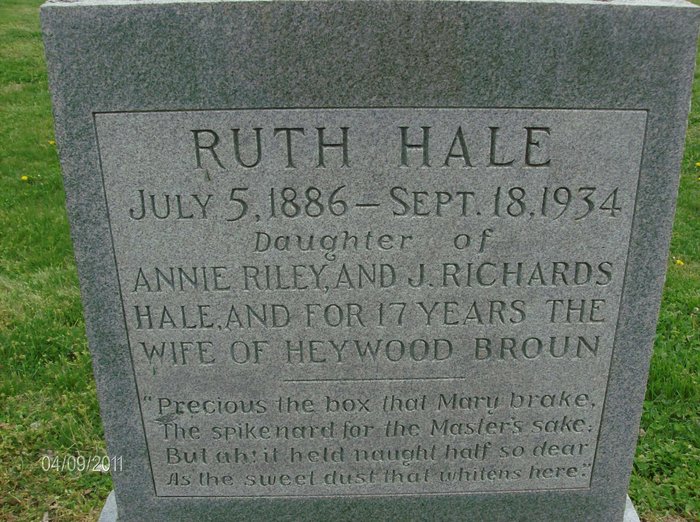
Ruth Hale was born in Rogersville, Tennessee, on 7/5/1886. At age 48, on 9/18/1934, she passed away in Stamford, Connecticut. Her ashes are interred at the Old Presbyterian Church Cemetery in Rogersville. (Source: “Ruth Hale Broun,” Find a Grave®.)

Ruth Hale, the journalist, is a 2024 posthumous inductee/honoree in the East Tennessee Writers Hall of Fame. (Source: Inductees/Honorees, East Tennessee Writers Hall of Fame.) She is one of thirteen inductees/honorees this year. The following is cited as the reason for her inclusion:

Ruth Hale (1887-1934) was a journalist and women’s rights activist. Born in Rogersville, Tennessee, Hale began writing for the Hearst Bureau in Washington, DC, when she was eighteen. She wrote for several influential newspapers and magazines, including the Washington Post, the Philadelphia Public Ledger, the New York Times, Vogue, the Chicago Tribune, and Vanity Fair. Hale was also a popular socialite and theatrical publicist and was a founding member of the Algonquin Round Table. Outside of her journalism career, Hale is best remembered as cofounder of the Lucy Stone League, a feminist organization, which fought for the rights of women to own property, receive paychecks, and register to vote using their maiden names even after marriage. She is buried in her East Tennessee hometown.

Her parents, James Richards Hale and Annie Riley Hale, were prominent residents in Rogersville. They had two children. Ruth Hale was the oldest. The Hales owned a large house near the town. James Hale was a lawyer and a horse breeder. (Interestingly, Ruth Hale refused to ride a horse sidesaddle.) Annie Hale, who lived to age 85, taught high school mathematics. James Hale was expelled from the Presbyterian Church for not believing in the virgin birth of Jesus. His tragic passing at the age of 41 negatively affected Ruth Hale, who was only ten years old at the time. Growing up, Ruth Hale and her mother often “butted heads” on social and political issues.

At age 13, Ruth Hale left home and continued her education in Roanoke, Virginia. She finished her formal education in Philadelphia, Pennsylvania. In Washington, D.C., at the age of 18, Ruth Hale began her career as a freelance journalist. She became a feature writer for several publications. She also became a champion for women's rights.

In New York City, on 6/6/2017, Heywood Campbell Broun (age 28, also a journalist) and Ruth Hale (age 30) were united in marriage. She refused to take his last name, defied the traditional floral bouquet, rejected the traditional wedding music, and refused to exchange wedding rings.

The newlywed couple became World War I correspondents in France until Ruth Hale became with child. The couple returned to New York City, and their only child, a son, was born on 3/10/1918.

Afterward, Heywood Broun and Ruth Hale, although still married, lived on separate floors of their New York City home. They continued their careers in journalism, with Hale often assisting Broun. Ruth Hale continued to advance her social and political agendas, for which she became well-known. The couple lived together or separately as the years unfolded.

In the late 1920s, Ruth Hale frequently lived alone and secluded at Sabine Farm, in Stamford, Connecticut. After 16 years and five months of marriage, Ruth Hale traveled to Mexico and obtained a divorce from her husband. Heywood Broun agreed, and their divorce was finalized on 11/17/1933.

Ten months and a day after their divorce, Ruth Hale passed away at the age of 48 on 9/18/1934. Her health had deteriorated. She had lost the use of her legs, stopped eating, and refused medical assistance. Her body was cremated.

Ruth Hale's mother, Annie Riley Hale, arranged to have the cremated remains of her daughter interred at the Old Presbyterian Church Cemetery in Rogersville. A train brought Ruth Hale's ashes to Rogersville, but a dispatcher had mistaken the urn for a bottle of pepper. He had placed the urn on a local grocery store shelf. The urn was retrieved and interred beside her father's grave in the Old Presbyterian Church Cemetery.

This summary relies on the following additional sources: “Rogersville native Ruth Hale fought for Women’s Rights,” The Rogersville Review, by Rodney Ferrell, 4/2/2023; “Ruth Hale,” Spartacus Educational, by John Simkin, 09/1997 (updated 01/2020); “Ruth Hale’s Fight for Her Name,” New-York Historical Society, by Emma Finn (Intern, Center for Women’s History), 8/13/2021; “Ruth Hale the Iconoclast,” Algonquin Round Table, by Kevin Fitzpatrick, 4/25/2022; “James Richards Hale,” Find a Grave®; and “Heywood Campbell Broun,” Find a Grave®.

Commentary

How did Ruth Hale's parents, James Richards Hale and Annie Riley Hale, get along? Both seemed to be intellectual. James Hale's opinion about the virgin birth of Jesus was a grave error, of course. What sparked Ruth Hale's forceful positions on the social and political issues of her time? We may never know.

Ruth Hale's journalistic accomplishments are notable. Her advocacy for the right of women to vote helped win that right (the 19th Amendment, 8/18/1920). She fought for a woman's right to own property in her own name. Ruth Hale seemed to be very strong-willed. I admire strong will, if it is headed in the right direction.

Reading about Ruth Hale, I found her life story somewhat disheartening and tragic. Her brilliance seemed to be quixotic in some pursuits, as if chasing windmills.

Conclusion

Ultimately, was Ruth Hale a Christian? Was she saved by the grace of God through Christ Jesus? Unfortunately, none of the sources that I found included any information on these vital questions.

What will be your life's legacy? What will be mine? What will be inscribed on our tombstones?

The inspired wisdom of Solomon concludes Ecclesiastes (12:13-14, NIV) by stating:

Now all has been heard;
  here is the conclusion of the matter:
Fear God and keep his commandments,
  for this is the duty of all mankind.
For God will bring every deed into judgment,
  including every hidden thing,
  whether it is good or evil.

“Fear” is understood in the sense of reverence. The complete understanding is that loving reverence for God inspires the doing of his will. God saves us to serve him, for his glory and our everlasting joy. That is the whole and complete purpose and meaning of life. Anything less comes up everlastingly too short. We either aim high and hit the mark, to our everlasting benefit, or we aim low and miss the target, to our everlasting sorrow.

I would like my tombstone to read, “He was a former poor beggar who found the Bread of Life. He lived life, trying to share that Bread.”

What about you, dear reader?

Monday, March 18, 2024

American Legion Post 21 in Historic Rogersville, Tennessee (published 3-18-2024; article #460)

Introduction

Have you ever been inside an M4A3 Sherman tank? This Appalachian Irishman has! I will explain in the childhood memories section, farther below.

“You might as well come in and stay for a while,” as Appalachian folks often say when someone drops by. The last two articles focused on areas within walking distance on East Main Street in historic Rogersville, Tennessee. The article from 3/2/2024 was about Burton's Service Station. The 3/13/2024 article was about Brown's Corner. (Seeking help from others, I'm still trying to learn how the area got its name. Lord willing, I hope to publish an article, if I find out.) This article, the 31st entry in the Appalachia - northeast Tennessee topic section, finishes a trifecta and focuses on a third location on East Main Street in my hometown.

The distance from the former Burton's Service Station (remodeled and under new ownership) to the American Legion is about three-tenths of a mile, or about a six-minute walk. Let's take a virtual walk, going east from Burton's Service Station to the American Legion. The roadside park (with the white oak tree and the monument) is along the way.

This article highlights the American Legion Post 21 and the M4A3 Sherman Tank. I will share childhood memories about the tank and the restoration of the tank in 2006.

American Legion Post 21

The majestic American Legion Post 21 has a commanding and dominant presence. The building rests atop the hill, east of where the off-ramp from Highway 11W (the bypass) meets East Main Street (old Highway 11W). Access is on American Legion Road.

From “Hawkins County War Memorial,” American Legion, 4/26/2018, we understand that the American Legion Post 21 was chartered in 1921. Two buildings, before the current location, had served the members. The current building was erected in 1949, especially to honor World War II veterans.

The 2018 article, cited previously, emphasized the need to preserve the building. Post members had sponsored a “Save Our American Legion Post 21 Benefit” fund. The article includes an image of the cornerstone, which reads “Hawkins County War Memorial.” Years ago, I saw and touched the cornerstone. I thanked God for the service of countless veterans. Their number includes many from Hawkins County, several of whom were and are my relatives.

All veterans, deceased and living, deserve the respect, admiration, and appreciation of all Americans. This article honors all veterans. Thank you for your service.

The M4A3 Sherman Tank

The M4A3 Sherman tank is visible in the above image. It is to the right (or south) of the American Legion Post 21. Sherman tanks and the soldiers who manned them were crucial to victory during World War II. For further reading, please consider the following two articles:

“M4 Sherman: 'Blunder' or 'Wonder' Weapon? The American-built Sherman medium tank was admittedly inferior to its German opponents. Yet, how did it help win the war in Northwest Europe?” Warfare History Network, Early Fall 2012 (Volume 11, No. 7), by Blaine Taylor

“The Sherman M4A3 Medium Tank.” The Sherman Tank Site: the place for all things Sherman Tank (undated), by Jon T.

As the caption below the next image states, I took the photograph on 6/24/2006, a Saturday afternoon. Dad (Earl Ferrell, 9/17/1927-1/25/2008) was still living and doing fairly well. Other family members and I had visited my father. I had learned that an Eagle Scout project had restored the Sherman tank. I stopped to take the photograph on my way back home.

Photograph by M. Fearghail on Saturday afternoon, 6/24/2006. The American Legion building in Rogersville, Tennessee, is behind and to the north (left) of the Sherman tank. The turret and gun barrel point to a corner of the building. The name on the tank is “Old Hickory.” The view looks east.

Back on 9/12/2006, I had considered writing an article titled “A Good Scout.” I never put down my thoughts into words until now. An article, if it's worth writing, is better late than never, even if it is written over seventeen years later!

Childhood Memories

In the late 1960s and early 1970s, a lifelong friend and his family lived in a house in the subdivision that is just south of and behind the American Legion Post 21. My friend and I are the same age. We still keep in touch. His mother and my mother (Betty Lou Wood Ferrell, 11/24/1932-12/27/2000) were friends.

Sometimes, during visits with my friend, we would walk the fairly short distance to the American Legion to explore the Sherman tank. We climbed onto the tank and up to the turret. We eased down the turret hatch into the crew compartment. Being of grade school age and body size, with youthful flexibility, we soon realized that moving around in the crew compartment was not easy!

A five-man crew operated Sherman tanks. The crew included the commander, the gunner, the loader, the driver, and the assistant driver/hull gunner. The crew compartment has two levels. The upper level was for the commander, the gunner, and the loader. The commander sat or stood behind the gun barrel and the gunner. The gunner sat immediately behind the gun barrel. The loader sat to the left of the gunner. The lower level was for the driver, who took the left seat, and for the assistant driver/hull gunner, who had the right seat. An excellent video description is seen on “Inside the 'Easy 8' Sherman Tank - Examining the Roles of a Tank Crew,” National Museum of Military Vehicles (YouTube), 2/4/2024. The nineteen-minute episode includes timestamps. The video from inside the crew compartment starts at the five-minute and thirty-second mark. It's worth watching.

My friend and I imagined that we, with three invisible crew members, fought tank battles against the Germans! The thick glass, encased in metal on the outside top of the turret, was cracked in several places, certainly from enemy fire. The tank exterior had numerous dings, dents, and marks, surely from enemy projectiles. That tank had seen its share of combat in World War II.

On many occasions, my friend and I paused our imaginary battles and wondered if any soldiers had died in that tank. Our imaginary battles became somber thoughts, at least for a while.

One visit to the Sherman tank included a real battle! My friend and I had lowered ourselves into the crew compartment. We encountered an angry swarm of waspers! They had nested inside the tank. Bounding out and off the tank quickly, we were not stung too many times! The waspers won that battle. Eventually, we returned, didn't find any waspers, and continued our imaginary battles. The good guys always won those battles.

My friend and his family moved to a nearby town at the beginning of our freshman year in high school. We still got together and kept in touch, but our visits to the Sherman tank had ended.

The Tank Restored in 2006

In the late 1960s and early 1970s, the Sherman tank was holding up well enough, despite weathering, rust, and slight deterioration. As I stated previously, I took the above photograph on 6/24/2006. I had learned that an Eagle Scout project had restored the Sherman tank. Dad kept issues of The Rogersville Review for us to read when we visited. We enjoyed reading the newspapers. For several years, I have kept an online and paper delivery subscription to The Rogersville Review. My wife and I like to keep up with the news from my hometown. Mrs. Appalachian Irishman also has family ties to Rogersville. Online editions of the newspaper are available by subscription only.

If you disable private browsing, however, you may be able to read, without the cost of a subscription, “Tank restored thanks to teen,” The Rogersville Review, by Bill Grubb, 6/14/2006. The article was published ten days before I had photographed the tank.

In summary, the 6/14/2006 article indicates that the M4A3 Sherman tank had been “standing guard” beside the American Legion Post 21 for fifty-four years. It began its guard duty in 1952. The tank had been on a two-year “leave of absence” while an Eagle Scout (named in the article) restored the tank for his Eagle Scout project. The restoration project also honored “a member of the Tennessee National Guard” who was killed during service in Iraq.

Conclusion

Since we parked our vehicles at the old Burton's Service Station, we might as well walk back there. Before leaving the American Legion and the Sherman tank, we pause at the “Hawkins County War Memorial” cornerstone, touch it, and lift up silent prayers to God for the sacrifices of all the soldiers who have served or are serving this nation.

The roadside park (with the white oak tree and the monument) is along the way. We stop to relax for a while at the picnic table under the shade of that oak tree.

Don't you wish that Burton's Service Station was still open? I would like to walk in and buy a glass-bottled Coke and a snack for 25 cents.

I have enjoyed our virtual walk. On the next visit to my hometown, will I walk from the old Burton's Store to the American Legion? We will see. You may see me resting near that old oak tree. I will wave if you honk at me!